
The first thing you notice is not the image, but the scent—a dry, earthy aroma of ground minerals and yak-hide glue, mingled with the high-altitude crispness of Himalayan air. Then, the silence of the monastery, punctuated only by the distant chant or the soft chime of a temple bell. This is the environment that gives birth to a Thangka. It is not merely an artwork; it is a sacred object, a portable portal to the enlightened mind. For the Western seeker, a Thangka represents a tangible connection to an ancient stream of wisdom, a focal point for a spirit yearning for depth in a world of surfaces. Your hope is to bring this profound energy into your life. Your fear is to mistake a shadow for the substance, to acquire a lifeless copy and inadvertently dishonor a tradition you deeply respect. This compendium is offered to address that very fear and to honor that noble hope. It is a transmission of understanding, a gift from the lineage, so you may engage with this Dharma art with the clarity and reverence it deserves.

Insights You Will Gain:
- The distinction between a Thangka’s spiritual lineage and its artistic creation.
- A functional understanding of the iconographic language—colors, mudras, and deities—as psychological and spiritual tools.
- An appreciation for the alchemy of sacred materials and the meditative state required for authentic creation.
- A respectful framework for integrating a Thangka into your personal spiritual practice.
- The knowledge to act as a guardian of this tradition through ethical and informed patronage.
The Origin & Lineage: Tracing the Divine Thread of Thangka Art
The story of the Thangka is not one of spontaneous invention, but of a sacred current flowing across mountains and through centuries. Its origins can be traced to the Pāla Empire of India (8th to 12th centuries), a period of extraordinary artistic and spiritual flourishing. As Mahayana and Vajrayana Buddhism blossomed, so too did the need for visual supports for meditation and teaching. These early painted scrolls, or ‘pata,’ traveled with monks and masters along the treacherous trade routes into the Himalayas. When this stream of Dharma reached the high valleys of Tibet, it merged with indigenous artistic sensibilities and the profound spiritual environment to become the Thangka we recognize today. This was not a simple act of copying; it was a dynamic transmission, a re-articulation of timeless truths in a new cultural language, creating a distinct and powerful form of Dharma art. The tradition was not simply about preserving an aesthetic, but about safeguarding a direct link to enlightened realization.
From the Palas of India to the Valleys of Tibet: The Birth of a Sacred Art
The journey from Indian ‘pata’ to Tibetan Thangka was a profound evolution. Early works were heavily influenced by the fluid lines and vibrant palette of the Pāla school. However, as the art form took root in Tibet, it began to incorporate the stark beauty and immense scale of the surrounding landscape. The cobalt blue of the sky and the rich ochre of the earth found their way into the mineral pigments. The structure became more formalized, more geometrically precise, reflecting the Vajrayana emphasis on order, structure, and the mapping of metaphysical realities. This transition was a testament to the adaptive genius of the tradition, demonstrating how a universal spiritual science could be expressed through a unique local lens without losing its core integrity or power. It was here that the Thangka became a quintessential expression of the Tibetan spiritual genius.
The Lineage Holders: How Masters Transmitted Wisdom, Not Just Technique
A Thangka’s spiritual potency, its ‘jinlab’ or blessing, is derived directly from its lineage. The transmission from master to student is a sacred commitment, a ‘Samaya,’ that extends far beyond technical instruction. The master imparts not just how to mix pigments or draw a perfectly proportioned deity, but the correct state of mind, the specific mantras, and the deep meditative visualizations that must accompany every brushstroke. This unbroken chain, stretching back through generations of accomplished yogis and artists, ensures that each new Thangka is not a mere reproduction, but a fresh vessel filled with the accumulated wisdom and spiritual energy of the entire lineage. Without this authentic transmission, a painting, no matter how technically brilliant, remains an empty shell—a beautiful object devoid of the sacred life that defines a true Thangka. This is the fundamental difference between art and Dharma art.
Paubha and Thangka: Unraveling the Nepalese-Tibetan Artistic Dialogue
No discussion of Thangka history is complete without honoring the profound contribution of the Newar artists of the Kathmandu Valley. The Nepalese painting tradition, known as Paubha, developed in parallel and in constant dialogue with its Tibetan counterpart. The legendary artist Arniko, a Newar master, traveled to the court of Kublai Khan in the 13th century, bringing the exquisite craftsmanship and refined aesthetic of his people to the highest echelons of power in Asia. For centuries, Newar artisans were sought after throughout Tibet for their unparalleled skill, particularly in fine metalwork and the delicate rendering of divine forms. This exchange created a vibrant fusion of styles. The Nepalese brought a certain grace, a sensuous warmth, and an incredible intricacy to the form, while the Tibetans contributed a profound depth of iconographic knowledge and a stark, powerful spiritual intensity. This creative synergy enriched both traditions immeasurably.
Beyond Decoration: Understanding the Thangka as a Vessel of Dharma
Ultimately, the purpose of a Thangka is not to decorate a wall but to transform the consciousness of the viewer. It is a functional tool, a ‘sacred map of the mind.’ Each element—from the precise iconometric grid that governs the proportions of the central deity to the symbolic offerings at the bottom and the lineage masters at the top—is designed to guide the practitioner’s mind away from ordinary, confused perception toward an enlightened view. It serves as a visual support for complex ‘generation stage’ meditations, where the practitioner visualizes themselves as the deity, embodying their enlightened qualities of compassion, wisdom, and power. The Thangka is therefore a constant reminder of one’s own innate Buddha-nature. It is not an object to be passively admired but actively engaged with, a vessel of Dharma that holds the potential for profound spiritual awakening when approached with the correct intention and understanding.
Reading the Cosmos: A Deep Dive into Thangka Iconography
To gaze upon a Thangka is to read a celestial language. It is a sophisticated system of symbols, colors, and gestures, each element precisely codified to convey complex spiritual and psychological truths. This is not art for art’s sake; it is a science of inner transformation expressed through visual form. The iconography of a Thangka is a universal grammar of enlightenment, where every detail, no matter how small, is imbued with layers of meaning. Understanding this language is the key to unlocking the Thangka’s power as a tool for meditation and self-discovery. It requires a shift in perception from seeing a ‘picture’ of a deity to understanding a complete, multi-dimensional blueprint for awakening. The figures are not historical persons in the conventional sense, but archetypes of enlightened qualities that exist, latent, within our own minds. The wrathful forms are not demons, but the dynamic, compassionate energy that annihilates ignorance. The serene Buddhas are not distant gods, but representations of the mind’s own stainless, peaceful nature.
The Sacred Grid: The Metaphysical Blueprint of Proportionality (Iconometry)
Before the first drop of paint touches the canvas, the Thangka is born from an invisible matrix of lines and angles known as the sacred grid, or ‘thig-tse’. This practice of iconometry is a foundational discipline, ensuring that every deity is rendered with divine, not human, proportions. These proportions are not arbitrary aesthetic choices; they are considered to be the energetic blueprint of the enlightened body. The precise measurements for the distance between the eyes, the length of the limbs, and the curve of the torso are detailed in sacred texts and have been passed down for centuries. Drawing this grid is itself a meditative act, a process of establishing cosmic order upon the blank canvas. This geometric foundation ensures that the deity’s form is a perfect vessel to hold and transmit the specific enlightened energy it represents. An improperly proportioned deity is considered energetically inert, incapable of serving its function as a conduit for blessing and a support for visualization practice.
The Five Dhyani Buddhas: Decoding Color, Direction, and Transformed Consciousness
Central to Vajrayana iconography are the Five Dhyani Buddhas, or Five Wisdom Buddhas, who represent the transmutation of the five primary mental poisons into five aspects of enlightened awareness. Each Buddha is associated with a specific color, direction, element, and gesture (mudra), creating a comprehensive system for understanding and transforming the psyche. For example, Akshobhya, the Buddha of the East, is blue; his element is water, and he transforms anger into mirror-like wisdom. Ratnasambhava, in the South, is yellow; his element is earth, and he transforms pride into the wisdom of equanimity. Amitabha, in the West, is red; his element is fire, and he transforms attachment and craving into discriminating wisdom. Amoghasiddhi, in the North, is green; his element is wind, and he transforms jealousy into all-accomplishing wisdom. Finally, Vairocana, at the center, is white; his element is space, and he transforms ignorance into the all-pervading wisdom of the ultimate reality (Dharmadhatu). This symbolic system is a profound psychological map, providing a practical method for working with our most challenging emotions.
| Color / Symbol | Associated Buddha / Element | Poison Transformed | Sacred Meaning & Resulting Wisdom |
|---|---|---|---|
| White / Wheel | Vairocana (Center) / Space | Ignorance | The wisdom of ultimate reality (Dharmadhatu). It represents the all-encompassing consciousness that sees the interconnectedness of all phenomena. |
| Blue / Vajra | Akshobhya (East) / Water | Anger / Aggression | Mirror-like wisdom. The ability to see things exactly as they are, without distortion or judgment, reflecting all phenomena impartially. |
| Yellow / Jewel | Ratnasambhava (South) / Earth | Pride / Greed | The wisdom of equanimity. Recognizing the fundamental sameness and preciousness of all beings, and the richness inherent in existence. |
| Red / Lotus | Amitabha (West) / Fire | Attachment / Desire | Discriminating wisdom. The ability to perceive the unique qualities of all things without clinging, understanding their true nature. |
| Green / Double Vajra | Amoghasiddhi (North) / Wind | Jealousy / Envy | All-accomplishing wisdom. The wisdom of perfect, effortless, and fearless action for the benefit of all beings. |
Wrathful Deities & Dharma Protectors: The Psychology of Fierce Compassion
To the uninitiated eye, the wrathful deities of the Tibetan pantheon—with their fearsome expressions, multiple limbs, and crowns of skulls—can be unsettling. They are often mistaken for demons or evil spirits. This is a profound misinterpretation. These figures are not expressions of malevolence; they are manifestations of ‘fierce compassion.’ They represent the incredibly powerful, dynamic, and unsubtle energy required to cut through the most stubborn obstacles to enlightenment: deep-seated ignorance, hatred, and fear. Their wrath is directed not at sentient beings, but at the ego-clinging and mental afflictions that cause suffering. Think of them as the spiritual equivalent of a surgeon’s scalpel—their function may appear violent, but their ultimate purpose is healing and liberation. They are Dharma Protectors (‘Dharmapalas’), guardians of the teachings and of practitioners, who vow to clear the path of all hindrances, both internal and external. Engaging with their imagery is an advanced practice for transforming one’s own powerful, aggressive energies into a force for wisdom and compassionate action.
The Alchemy of Creation: Where Meditative State Meets Masterful Skill
The creation of a Thangka is a work of alchemy, a sacred process where raw matter is transmuted into a vessel of spirit. It is an undertaking that demands more than just artistic talent; it requires immense patience, deep faith, and a stable meditative mind. The artist is not merely a painter but a yogi, a practitioner whose inner state is as crucial to the final creation as the pigments they apply. This profound integration of the material and the metaphysical is what fundamentally distinguishes a genuine Thangka from a commercial replica. The user’s fear of acquiring a soulless object is valid, because the soul of a Thangka is infused during its creation. It is born from the artist’s ‘Sadhana’—their daily spiritual practice of meditation, mantra recitation, and visualization. Every element, from the hand-prepared canvas to the final brushstroke of gold, is part of a ritual aimed at invoking the divine presence, not just depicting it. The physical materials are not inert; they are chosen for their symbolic resonance and are believed to carry their own inherent energies.
Preparing the Canvas (Gesso): The Foundation of Sacred Space
The process begins not with a sketch, but with the preparation of the canvas, an act of creating a pure foundation. A piece of cotton or linen is stretched taut on a wooden frame. It is then coated with multiple thin layers of a gesso made from a mixture of chalk or white clay and a hide glue, often from a yak. Each layer is applied, allowed to dry, and then meticulously polished with a smooth stone or conch shell. This laborious process can take weeks, resulting in a surface that is flawlessly smooth, luminous, and durable—a worthy ground for depicting an enlightened being. This preparation is more than a technical step; it is a meditation on purity and preparation. The artist is creating a ‘pure realm,’ a perfect field upon which the sacred image will manifest. The flawless white surface represents the pure, untainted nature of mind, the ‘ground of being,’ before the elaborations of thought and form arise. It is the emptiness from which all sacred phenomena will emerge.
Grinding Gems: The Metaphysics of Mineral Pigments
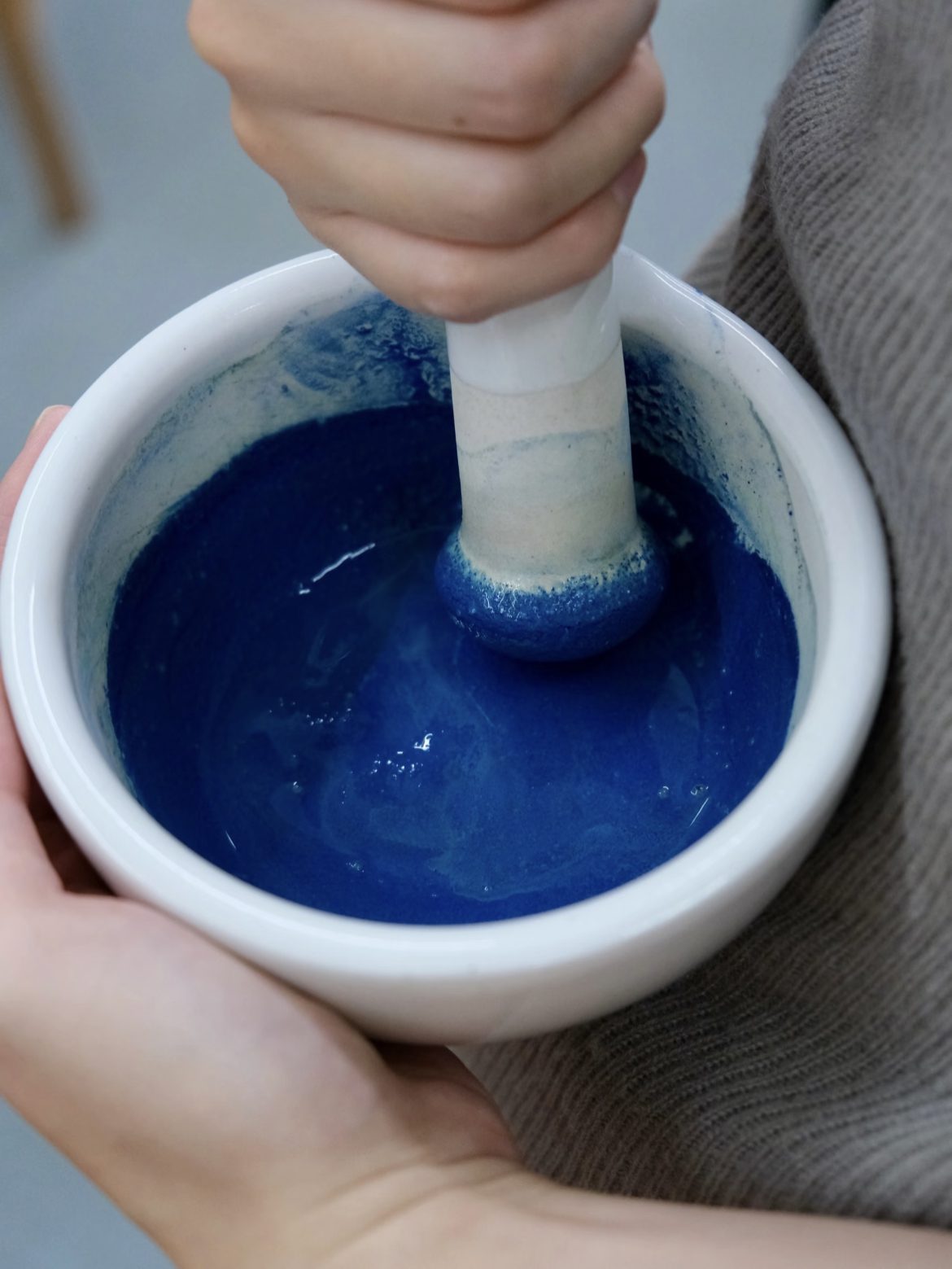
The soul-stirring vibrancy of a Thangka comes from its use of natural mineral pigments. These are not synthetic colors from a tube; they are painstakingly ground by hand from precious and semi-precious stones. Lapis lazuli for deep, celestial blues; malachite for vibrant greens; cinnabar and ochre for rich reds and yellows; azurite for a different shade of blue. Each stone is crushed, ground with a mortar and pestle, and mixed with the hide glue binder. This process is an art in itself, as the particle size determines the shade and brilliance of the final color. Metaphysically, this practice is deeply significant. The artist is imbuing the painting with the essence and energy of the earth itself. The deep blue of lapis lazuli, for example, is not just a color; it is energetically linked to the healing vibrations of the Medicine Buddha. The radiant red of cinnabar carries the energy of power and magnetism associated with deities like Vajrayogini. The use of these precious, natural materials infuses the Thangka with a living quality, a material integrity that cannot be replicated with modern acrylics or inks.
The Artist as Yogi: The Role of Sadhana and Mantra in the Painting Process
For a lineage artist, the act of painting is inseparable from their spiritual practice. Before beginning a Thangka, especially of a specific deity, the artist will often undertake a retreat, engaging in intensive meditation and recitation of the deity’s mantra to purify their mind and deepen their connection. Throughout the painting process, this practice continues. While mixing pigments or applying fine lines, the artist recites mantras, maintaining a state of meditative concentration. They are not simply copying a design; they are invoking the deity, inviting its presence to inhabit the form they are creating. It is believed that the artist’s state of mind is transmitted directly into the brush and onto the canvas. A mind filled with peace, devotion, and concentration will create a Thangka that radiates those qualities. A distracted or agitated mind will create an energetically dead object. This is why the ‘Samaya’ and spiritual discipline of the artist are considered paramount—they are the true source of the Thangka’s blessing power.
The Golden Touch: The Symbolic Importance of 24k Gold in Divine Art
The application of gold is one of the final and most delicate stages in creating a Thangka. Genuine 24k gold is ground into a fine powder, mixed with the glue binder, and painstakingly applied with the finest of brushes to create halos, ornaments, brocade patterns, and the radiant lines that define the deity’s form. Gold is used not for ostentation but for its profound symbolism. It represents the light of wisdom, the purity of enlightenment, and the preciousness of the Dharma. Its incorruptible nature symbolizes the unchanging, eternal quality of the enlightened mind. The radiance of the gold is meant to evoke the luminous, blissful nature of reality itself. In a dark temple hall, illuminated only by the flickering light of butter lamps, the golden elements of a Thangka seem to come alive, shimmering with a divine energy that draws the viewer’s mind into a state of reverence and awe. The use of real gold is a hallmark of authenticity and an act of supreme offering to the enlightened beings depicted.
Spiritual Application: Integrating a Thangka into Your Life and Practice
Acquiring an authentic Thangka is not the culmination of a journey; it is the beginning. You have become the custodian of a sacred object, a tool designed for the explicit purpose of awakening the mind. To simply hang it on a wall as one would a secular piece of art is to miss its essential function. Integrating a Thangka into your life is an art of intention and respect, a way to create a continuous stream of blessing and mindfulness in your daily existence. It does not require you to become a Tibetan Buddhist monk, but it does ask for a shift in perspective—from seeing the Thangka as a possession to relating to it as a presence. The aim is to allow its sacred energy to permeate your space and your consciousness, serving as a constant, silent reminder of your highest potential. This relationship transforms a room into a sacred space and moments of idle thought into opportunities for contemplation. For the modern seeker, this provides a powerful anchor, a focal point of stability and profound meaning that is both accessible and deeply transformative.
Choosing Your Yidam: How to Select a Deity Thangka that Resonates with Your Path
In the Vajrayana tradition, a practitioner often works with a ‘Yidam,’ or meditational deity, that represents a specific aspect of enlightenment with which they have a personal connection. While this choice is traditionally guided by a qualified lama, a layperson can still make an intuitive and beneficial selection. The key is to reflect on your own spiritual needs and aspirations. Are you seeking to cultivate boundless compassion? A Thangka of Avalokiteshvara (Chenrezig) would be appropriate. Do you wish to overcome obstacles and develop fearless, compassionate action? Green Tara might call to you. Are you working to heal physical or mental afflictions? The deep blue form of the Medicine Buddha could be a powerful support. Spend time looking at different deities and read about their qualities. Notice which one resonates with you on a deeper level, not just aesthetically, but emotionally and spiritually. This intuitive connection is a sign of a karmic link and indicates that working with this particular energy will be fruitful for your personal journey.
Creating a Sacred Space: The Art of Respectful Placement and Veneration
Once you have chosen your Thangka, its placement is of primary importance. It should be housed in a clean, quiet, and respected area of your home, preferably the place where you meditate or spend quiet time. Ideally, it should be placed high on a wall, above eye level when you are seated, signifying respect for the enlightened principles it represents. It should never be placed in a mundane area like a bathroom, or in a position where people’s feet would point towards it, such as at the foot of a bed. You can create a simple shrine or altar below the Thangka. This need not be elaborate; a small table with a clean cloth is sufficient. You can place offerings on it, which are symbolic representations of your devotion and aspiration. Traditionally, these include bowls of clean water (representing purity), candles or lights (representing wisdom dispelling ignorance), incense (representing ethical discipline), flowers (representing generosity and beauty), and perhaps a small image of your own spiritual teacher. The act of maintaining this space is itself a mindfulness practice.
A Practical Guide to Thangka Meditation: The Stages of Visualization
A Thangka is the perfect support for what is known as ‘generation stage’ meditation. The practice is straightforward in its structure, yet profound in its effect. Begin by sitting comfortably in front of your Thangka, allowing your mind to settle. First, simply gaze at the image (this is known as ‘darshan,’ or seeing the divine). Let your eyes relax and take in the colors, the form, and the overall presence of the deity. Allow a feeling of reverence and openness to arise. Next, close your eyes and attempt to visualize the deity in your mind’s eye, recalling the details from the painting. Make the image as vivid and stable as possible. See it not as a flat painting, but as a living, breathing being made of radiant light. Then, feel that the deity’s enlightened qualities—such as the compassion of Avalokiteshvara or the wisdom of Manjushri—radiate from the image as colored light, entering your body and mind, purifying all negativity and filling you with blessing. You can coordinate this with the recitation of the deity’s mantra. Conclude by dissolving the visualization and resting in the open, luminous state of awareness that remains. This practice gradually familiarizes your mind with the qualities of enlightenment.
Cultural Preservation: Protecting a Priceless Heritage in the 21st Century
In our modern era of digital reproduction and global commerce, the ancient art of Thangka painting faces an unprecedented threat. The very qualities that make it a profound spiritual tool—the meditative process, the use of sacred materials, the lineage transmission—are being eroded by the demand for cheap, mass-produced replicas. This situation directly addresses the seeker’s deepest fear: acquiring a beautiful but spiritually void object. The market is flooded with printed canvases and paintings created by artists with no connection to the spiritual lineage, using acrylic paints and shortcuts that bypass the sacred process. Choosing an authentic Thangka, therefore, is no longer just a personal spiritual decision; it has become a powerful act of cultural preservation. By seeking out and supporting true lineage artists, you do more than acquire a tool for your own awakening. You become a guardian of this wisdom, casting a vote for integrity over convenience and ensuring that this priceless heritage can continue to flourish and benefit beings for generations to come. Your choice has the power to protect an entire cultural and spiritual ecosystem.
The Threat of the Soulless Replica: Digital Printing vs. Hand-Ground Pigments
The most significant threat is the proliferation of printed reproductions. These are photographs of Thangkas printed onto canvas, sometimes with a few dabs of paint or gold marker added to simulate texture. From a distance, they can be deceptive, but they are entirely devoid of the life force of a genuine painting. They lack the luminosity of hand-ground mineral pigments, the subtle texture of the gessoed canvas, and most importantly, the spiritual imprint of the artist’s meditative concentration. A printed Thangka is a ghost, an echo of a sacred form. Similarly, many paintings are now created with modern acrylics or watercolors. While these may be hand-painted, they lack the metaphysical connection to the earth’s energy that comes from using mineral pigments. The colors often appear flat and lifeless in comparison. These replicas are produced quickly, with the goal of commercial volume, not spiritual transmission. They are the physical embodiment of the user’s fear of the meaningless fake, a commodity that mimics the sacred without containing any of its power.
Discerning Authenticity: Key Markers of a Lineage Thangka
Educating oneself is the primary defense against acquiring a replica. There are several key markers of an authentic, high-quality Thangka. First, examine the surface. A genuine Thangka will have a subtle, matte texture from the mineral pigments, unlike the uniform sheen of a print or the plastic-like finish of acrylics. Look closely at the lines; they should be incredibly fine and precise, especially the gold details, which should be raised and catch the light with a unique shimmer. The color palette itself is a clue; the deep, resonant hues of lapis, malachite, and cinnabar are difficult to replicate with synthetic paints. The overall presence of the piece is also a factor. A true Thangka has a palpable energy, a vibrancy and depth that feels alive. It draws you in. Finally, and most importantly, inquire about the artist and their lineage. A reputable seller or studio, like Tanfog, will be transparent about the artist who painted the piece, their teacher, and the tradition they uphold. This provenance is the guarantee of the Thangka’s spiritual integrity.
Ethical Patronage: How Supporting True Artisans Protects an Entire Culture
When you choose to invest in an authentic Thangka from a known lineage artist, you are engaging in ethical patronage. Your support extends far beyond a single transaction. It provides a livelihood for an artist who has dedicated their life to a rigorous, multi-year apprenticeship and a continuous spiritual practice. It helps fund the studios and schools where the next generation of artists are being trained, ensuring the transmission continues. It sustains the entire network of artisans who support this craft, from the carpenters who build the frames to the individuals who source and prepare the raw materials. By rejecting mass-produced fakes, you are actively starving the market that exploits and dilutes this sacred tradition. Your patronage becomes a direct lifeline, a statement that you value authenticity, discipline, and spiritual integrity. You are no longer just a consumer; you are a partner in preservation, a benefactor who is helping to keep a lamp of ancient wisdom lit in the modern world.
The Living Tradition: Thangkas Not as Museum Pieces, but as Active Tools for Awakening
While some ancient Thangkas are rightfully preserved in museums, the tradition itself is not a relic of the past. It is a living, breathing art form whose purpose is profoundly contemporary: to provide a method for working with the mind. A Thangka is not meant to be sealed behind glass, viewed with detached academic curiosity. It is meant to be lived with, meditated upon, and integrated into one’s daily life. Each new Thangka painted by a lineage holder is a fresh pulse of the Dharma, a newly consecrated portal available for a modern practitioner. By bringing one into your home, you are participating in this living tradition. You are affirming that these ancient maps of the mind are more relevant than ever, offering a path to inner peace, compassion, and clarity. To be a guardian of this tradition is to recognize the Thangka not as a static artifact, but as a dynamic and potent technology for human transformation, as vital and necessary today as it was a thousand years ago in the high mountains of Tibet.
The Wisdom FAQ
- Is a Thangka considered an object of worship?A Thangka is not an idol to be worshipped in the way one might worship a deity in a theistic religion. It is more accurately described as a support for practice and a vessel of blessing. The reverence shown to a Thangka is respect for the enlightened principles it represents—the same principles latent within the practitioner’s own mind. One is venerating the potential for enlightenment itself, not an external god.
- What is the significance of the silk brocade frame?The traditional silk brocade border is considered an integral part of the Thangka. It functions as a ‘celestial mansion’ or frame for the sacred image, separating the pure realm of the deity from the ordinary world. The colors are often symbolic: yellow and red are common, representing the earth and the fire of wisdom. A thin red and yellow ‘rainbow’ strip, the ‘janga’, often directly borders the painting, symbolizing a divine boundary. A silk cover is also attached to protect the painting and is only drawn back during practice or viewing, a gesture of respect.
- Can someone who is not a Buddhist benefit from a Thangka?Absolutely. While the Thangka is rooted in Vajrayana Buddhism, its core principles are universal. The qualities represented—compassion, wisdom, peace, and strength—are aspirations shared by people of all spiritual paths and secular traditions. Simply having a Thangka in one’s space can create an atmosphere of peace and mindfulness. Its intricate beauty can be a source of inspiration, and meditating on its form can be a powerful way to calm the mind, regardless of one’s philosophical beliefs.
- What does the ‘consecration’ or ‘opening the eyes’ ceremony entail?After a Thangka is completed, it is considered a beautiful but lifeless object until it is consecrated by a qualified lama or high-level practitioner. During this ritual, the lama invites the wisdom being—the actual enlightened deity—to merge with and inhabit the physical painting. Mantras are recited, and syllables like OM, AH, HUM are often inscribed on the back of the Thangka, corresponding to the deity’s body, speech, and mind. The final act is the ‘opening of the eyes,’ where the lama paints the pupils of the deity’s eyes, symbolizing the infusion of enlightened consciousness. Only after this ceremony is the Thangka considered a true, living vessel of Dharma.
- How does the concept of ’emptiness’ relate to Thangka art?This is a profound point. In Buddhist philosophy, ’emptiness’ (Shunyata) does not mean nothingness, but rather the lack of inherent, independent existence. Forms arise from emptiness, are imbued with emptiness, and dissolve back into emptiness. A Thangka beautifully illustrates this. The deity’s form, though vividly depicted, is understood to be a manifestation of emptiness—a luminous, compassionate display arising from the ultimate nature of reality. Meditating on a Thangka helps the practitioner understand that both the self and phenomena are like this divine image: appearing yet empty, empty yet appearing. This insight is the dawn of wisdom.
The Guardian’s Reflection
A Thangka begins with a silent vow in the heart of an artist and ends with a silent recognition in the heart of a seeker. It is a bridge across time, a conversation between a lineage of awakened minds and your own innate potential. To hold this knowledge of its creation, its language, and its purpose is to accept a sacred responsibility. You are no longer a mere admirer, but a custodian. In a world that often prioritizes the fleeting over the timeless, your informed and ethical engagement becomes an act of profound merit. By honoring the Samaya of the artist, by respecting the vessel of Dharma, and by allowing its blessings to unfold in your life, you become a guardian of this wisdom—ensuring that these sacred maps of the spirit continue to guide humanity toward the luminous ground of its own being.
References:
Metropolitan Museum of Art https://www.metmuseum.org
British Museum https://www.britishmuseum.org
Asia Society https://asiasociety.org