

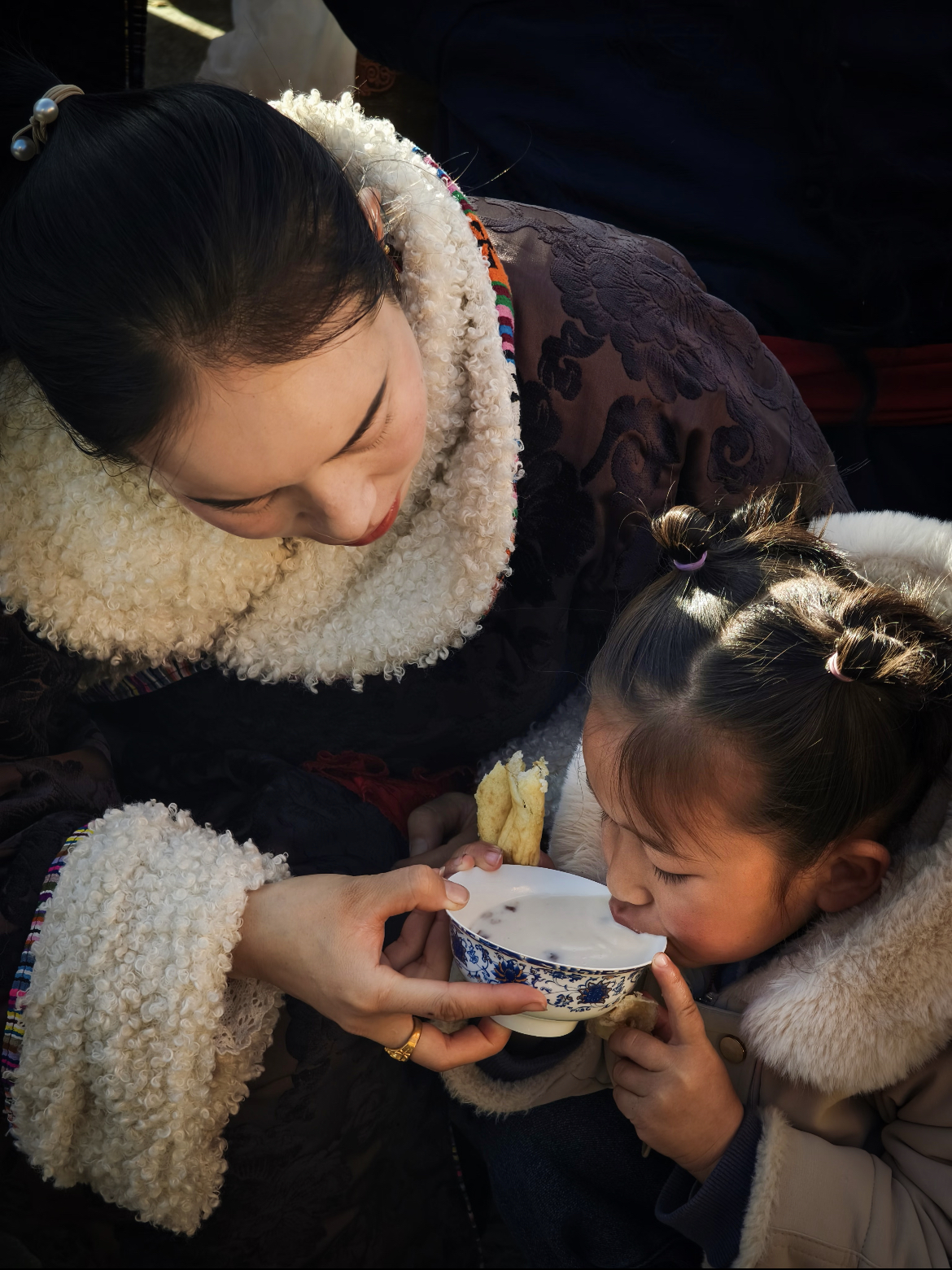
The cold, thin air of the high Himalayas carries a distinct scent—a blend of juniper incense, butter lamps, and the ancient stone of the lhakang, the temple chapel. It is in this atmosphere that a unique form of sacred art was perfected, an art that is not merely displayed but is lived, breathed, and meditated upon. You have arrived here not by accident, but guided by a quiet longing for something authentic, a connection to a wisdom that transcends the mundane. Your hope is to find a piece of art that is also a portal to the sacred, and your apprehension is that you might mistake a hollow echo for the genuine voice of the Dharma. This compendium is offered as a bridge. It is not a mere collection of facts, but a transmission—a respectful unfolding of the knowledge that constitutes the lifeblood of the thangka, the living scroll of Tibetan Buddhism. Consider this an extension of the lineage, a gift to the earnest seeker.
Insights You Will Gain
- An understanding of the thangka’s unbroken historical lineage, from cave murals to consecrated scrolls.
- The ability to decode the sacred iconography, colors, and gestures that form the thangka’s spiritual language.
- An appreciation for the alchemical process of creation, where meditative focus transforms raw earth minerals into a vessel for enlightenment.
- Practical guidance on how to use a thangka as a powerful support for meditation and spiritual practice.
- The knowledge to discern authentic Dharma art from commercial replicas, empowering you to become a guardian of this living tradition.
The Unbroken Thread: Origin and Lineage of the Thangka
The thangka did not emerge from a vacuum; it is the culmination of a spiritual and artistic current flowing across Asia for centuries. To hold a thangka is to hold the end of a golden thread that stretches back to the earliest days of Buddhist art. Its story is one of migration, synthesis, and profound devotion, a narrative of how the teachings of the Buddha found a unique and powerful visual expression on the Tibetan plateau. This is the essence of its lineage: an unbroken chain of transmission from master to disciple, ensuring both the technical skill and, more importantly, the spiritual integrity of the art form.
From Cave Murals to Sacred Scrolls: Tracing the Roots
The earliest precursors to the thangka can be found in the magnificent cave murals of Ajanta and Ellora in India, dating back to the 2nd century BCE. These large-scale frescoes depicted Jataka tales—stories of the Buddha’s past lives—and established a visual vocabulary for Buddhist teachings. As Buddhism traveled along the Silk Road, this artistic tradition was carried with it. However, the nomadic lifestyle of many Tibetan communities and the need for portable religious objects for itinerant teachers necessitated a new format. The answer was the scroll painting, which could be easily rolled up, transported, and unfurled in a tent or monastery for teaching and ceremony. Early Tibetan paintings from the 11th and 12th centuries show a strong influence from the Pala dynasty of Eastern India, characterized by bold outlines and vibrant, primary color palettes.
The Confluence of Cultures: Nepalese Paubha and Tibetan Innovation
A pivotal moment in the thangka’s development came through a vibrant cultural exchange with the Newar artists of the Kathmandu Valley in Nepal. The Newar paubha, a similar tradition of sacred scroll painting, was renowned for its exquisite detail, refined color blending, and masterful use of gold. In the 13th century, the great Newar artist Arniko was invited to the court of the Mongol ruler Kublai Khan, and his influence, along with that of his disciples, profoundly shaped the artistic landscape of Tibet. This fusion of Indian spiritual iconography, Nepalese artistic finesse, and Tibetan philosophical depth created the classical thangka style we recognize today. The Tibetans were not mere imitators; they innovated, developing complex iconographic systems and compositional structures like the mandala to map out the entire Buddhist cosmos on a single piece of cloth.
Schools of Thought and Brush: Understanding the Major Lineages
Over time, distinct schools or lineages of thangka painting emerged, each with its own stylistic characteristics. The **Menri** school, founded in the 15th century, is known for its spacious compositions, emphasis on serene blue and green landscapes, and delicately rendered figures. It became the dominant style in Central Tibet. The **Karma Gadri** school, originating in Eastern Tibet, was influenced by Chinese landscape painting, often featuring ethereal, atmospheric backgrounds and a more dynamic sense of movement in its figures. The **Newar** school, while originating in Nepal, has been a continuous source of influence and is prized for its vibrant red backgrounds, intricate gold detailing, and powerful, expressive deities. Understanding these lineages allows one to appreciate the subtle yet profound differences in how the Dharma is visually articulated.
More Than Art: The Thangka as a Vessel of Dharma Transmission
Ultimately, the lineage of the thangka is not merely stylistic; it is spiritual. A true thangka artist does not simply learn to paint; they receive empowerments, study the scriptures, and engage in the meditative practices associated with the deities they depict. The painting is a form of practice itself. The precise measurements, colors, and implements are not arbitrary artistic choices; they are prescribed by sacred texts (sutras and tantras) to create an accurate and potent support for visualization. The thangka is therefore a vessel, carrying the blessings and the wisdom of the entire lineage—from the Buddha himself, through the great Indian and Tibetan masters, to the artist who applies the final brushstroke. It is a living embodiment of the Dharma, not a static religious artifact.
Reading the Sacred Blueprint: A Guide to Thangka Iconography
A thangka is far more than a beautiful image; it is a meticulously constructed spiritual map, a blueprint of enlightenment. Every color, posture, and object within its frame is a symbol, a key that unlocks a specific aspect of Buddhist philosophy and practice. To learn to read a thangka is to learn the language of awakening. This is the study of iconography, the sacred grammar that transforms pigmented cloth into a profound tool for inner transformation. Without this understanding, one sees only the surface. With it, one perceives a dynamic interplay of wisdom, compassion, and enlightened energy, a direct visual teaching passed down through an unbroken lineage.
The Divine Architecture: The Grid, The Mandala, and Cosmic Order
The creation of a thangka begins not with a freehand sketch, but with a precise geometric grid known as a ‘thigse’. This grid dictates the exact proportions of the central deity according to canonical scriptures. The size of the head in relation to the torso, the length of the arms, the placement of the eyes—every element is mathematically determined. This is not artistic constraint but spiritual necessity; the perfect form of an enlightened being is a reflection of perfect inner qualities. The entire composition is often structured as a mandala, a celestial palace or sacred realm. The central figure occupies the center, surrounded by their retinue, lineage masters above, and protector deities below. This structure mirrors the cosmic order and provides a complete field for meditative visualization, guiding the practitioner from the periphery of the mundane world to the enlightened heart of the deity.
The Pantheon of Awakening: Identifying Buddhas, Bodhisattvas, and Protector Deities
The figures depicted in thangkas represent the vast spectrum of the enlightened mind. **Buddhas**, like Shakyamuni or Amitabha, are fully awakened beings who have transcended cyclic existence. They are often depicted with specific marks of perfection, such as the ‘ushnisha’ (cranial protuberance) and long earlobes. **Bodhisattvas**, such as Avalokiteshvara (Chenrezig) or Tara, are enlightened beings who have postponed their own final nirvana out of compassion to help all sentient beings. They are often adorned with divine silks and jewels, symbolizing their active engagement with the world. **Protector Deities** (Dharmapalas), like Mahakala or Palden Lhamo, are often depicted in wrathful forms. This wrath is not anger but a powerful, focused energy that destroys obstacles to enlightenment and protects practitioners from inner and outer harm. Their fierce appearance symbolizes the transformative power of wisdom that cuts through ignorance and delusion.
The Language of Colors: The Five Elemental Hues and Their Mineral Origins
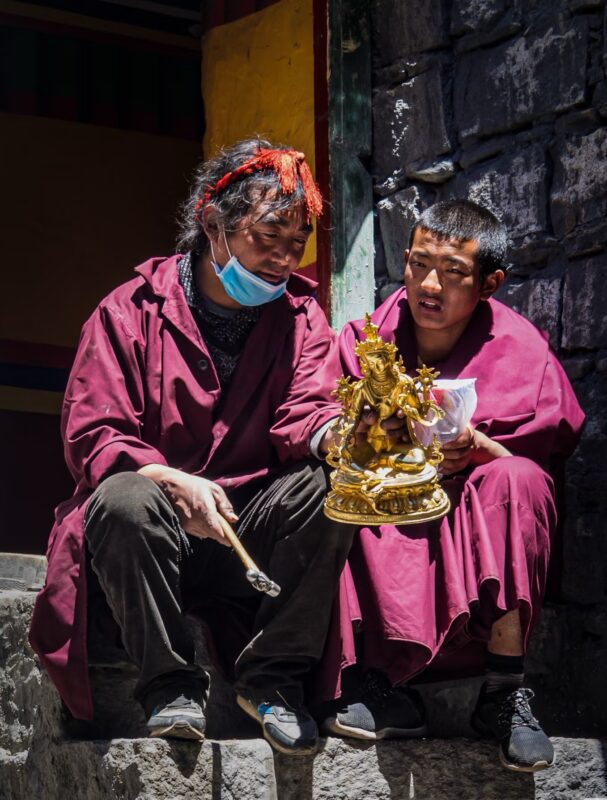
The vibrant colors of a traditional thangka are not synthetic pigments but are ground from the earth itself. These minerals carry their own energetic properties and symbolic meanings, corresponding to the five elements and the five Buddha families. This elemental language infuses the painting with a subtle power.
| Color & Symbol | Mineral Origin | Sacred Meaning & Element | Associated Buddha Family |
|---|---|---|---|
| White (Peace, Purity) | White Clay, Calcite | Pacifying Obstacles, Element of Water | Vairocana (Center) |
| Blue (Wisdom, Healing) | Lapis Lazuli, Azurite | Transmutation of Anger, Element of Space/Ether | Akshobhya (East) |
| Yellow (Abundance, Equanimity) | Orpiment, Ochre | Increasing Qualities, Element of Earth | Ratnasambhava (South) |
| Red (Power, Magnetism) | Cinnabar, Red Ochre | Overcoming Desire, Element of Fire | Amitabha (West) |
| Green (Enlightened Activity) | Malachite | Accomplishing Action, Element of Wind/Air | Amoghasiddhi (North) |
Gestures of Enlightenment: Decoding Mudras, Asanas, and Sacred Implements
The posture (`asana`) and hand gestures (`mudra`) of a deity are a form of sign language conveying their specific function. The ‘earth-touching’ mudra of Shakyamuni Buddha signifies his victory over temptation. The ‘fearlessness’ mudra, with the palm facing outward, offers protection and reassurance. Similarly, the objects a deity holds are extensions of their enlightened qualities. The `vajra` (diamond scepter) represents the indestructible nature of enlightenment, while the `ghanta` (bell) symbolizes wisdom and emptiness. The lotus flower held by Avalokiteshvara signifies purity that arises unstained from the mud of worldly existence. By understanding this rich symbolic vocabulary, the viewer can move beyond passive observation and actively engage with the thangka as a source of profound, non-verbal teaching.
The Alchemy of Devotion: The Creation of a Living Image
The distinction between an authentic thangka and a mere decorative painting lies not only in its subject matter but in the sacred process of its creation. This is a form of spiritual technology, an alchemical practice where material substances are transformed through ritual, intention, and meditative absorption into a vessel worthy of hosting a divine presence. The artist is not simply a craftsperson but a yogi, a conduit through which the sacred geometry of enlightenment takes form. This meticulous, devotional process directly addresses the fear of inauthenticity; a genuine thangka is imbued with a spiritual potency that cannot be replicated by mechanical means or a disconnected mind. It is this infusion of spirit that makes the image ‘living’.
Preparing the Vessel: The Sacred Geometry and Consecration of the Canvas
The journey begins with the canvas, typically a fine cotton or linen. It is stretched over a wooden frame and treated with a mixture of gesso, a blend of chalk or white clay and animal hide glue. This surface is painstakingly polished with a smooth stone or shell until it achieves a flawless, glass-like finish, ready to receive the sacred lines. This physical preparation is inseparable from the spiritual one. Throughout the process, the artist recites mantras, purifying the materials and the space. The initial drawing of the iconographic grid, the ‘thigse’, is itself a meditative act, establishing the perfect proportions that are a manifestation of the deity’s enlightened mind. The canvas is not just a surface; it is being prepared as a ‘kyil khor’, a sacred ground for the deity to manifest.
Ground from the Earth: The Metaphysical Properties of Mineral Pigments
The soul of a thangka’s color palette comes directly from the earth. Traditional painters eschew modern acrylics or oils in favor of mineral pigments, which they grind by hand on a stone slab. Lapis lazuli for deep blues, malachite for vibrant greens, cinnabar for potent reds, and orpiment for rich yellows—each mineral is believed to hold the essence of the element it represents. The binding agent is a hide glue mixed with water, creating a matte, opaque paint that has a unique luminosity and depth. Gold, painstakingly ground from 24-karat leaf and mixed into a paint, is used for the finest details, symbolizing the radiant light of wisdom and purity. The use of these precious, natural materials is an offering in itself, and their inherent stability ensures the painting can last for centuries, carrying the blessings of the lineage forward through time.
The Artist as Yogi: Meditation, Mantra, and the State of Mind in Creation
Perhaps the most crucial ingredient in a thangka is one that cannot be seen: the artist’s state of mind. Before beginning to paint a specific deity, the artist will often perform a short retreat, reciting the deity’s mantra and engaging in the visualization practice (sadhana) associated with them. This is done to internalize the qualities of the deity—their compassion, wisdom, or power. During the act of painting, the artist strives to maintain a state of meditative concentration, or ‘samadhi’. The brushstrokes are not just technical movements; they are expressions of this focused, devotional awareness. It is this sustained mental clarity and spiritual intention that infuses the painting with ‘chinlab’, or spiritual blessing. A thangka painted with a distracted or commercial mindset, even if technically perfect, is considered spiritually inert.
The ‘Opening of the Eyes’: The Final, Vital Ceremony of Animation
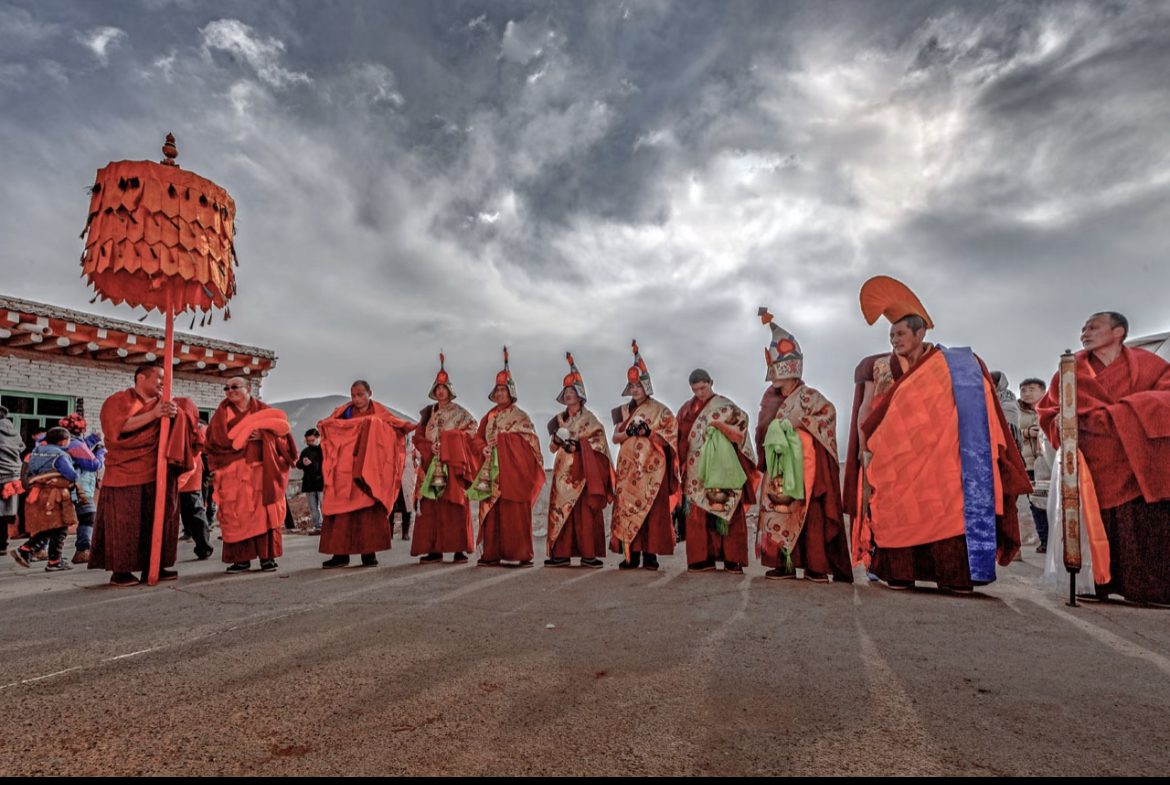
A thangka is considered incomplete, a beautiful but empty vessel, until the final and most vital step. After the painting and brocade mounting are finished, the artist, or often a high lama, performs the ‘rabne’ or consecration ceremony. In a state of deep meditation, the artist paints the eyes of the central deity. This single act is known as the ‘opening of theeyes’ and is believed to invite the consciousness of the enlightened being to reside within the image. During the ceremony, mantras associated with the deity are inscribed on the back of the thangka, often corresponding to the deity’s head, throat, and heart centers. These syllables act as a permanent spiritual seal. It is through this sacred ritual that the thangka is transformed from a masterful piece of Dharma art into a living presence, a true object of refuge and a portal to the divine.
Connecting with the Divine: Using a Thangka for Spiritual Practice
Acquiring an authentic thangka is the beginning of a profound relationship. This sacred scroll is not meant to be a static piece of decor but a dynamic tool for spiritual awakening. Its purpose is to serve as a support for your practice, a mirror reflecting the enlightened potential within you. For the modern seeker, integrating a thangka into one’s life is about creating a bridge between ancient wisdom and contemporary spiritual aspiration. It requires a mindset of respect, intention, and a willingness to engage with the image on a level that transcends the purely aesthetic. To do so is to unlock its true power as a guide, a protector, and a source of perpetual inspiration on the path.
Creating a Sacred Space: Placement, Intention, and Respect
The first step in working with a thangka is to establish a worthy place for it in your home. Traditionally, a thangka is placed in a high, clean, and respected location, never on the floor or in a mundane area like a bathroom. Often, this is an altar or a dedicated meditation space. The key is intention. By placing it thoughtfully, you are designating that area as sacred ground. It should be positioned higher than one’s head when seated in meditation, as a sign of reverence. Before beginning a practice, it is common to make a simple offering, such as a bowl of water, a stick of incense, or a candle, acknowledging the thangka not as an object, but as the embodiment of an enlightened presence. This act of creating a sacred space cultivates a mindset of mindfulness and prepares you to connect more deeply with the artwork’s spiritual essence.
The Thangka as a Mirror: A Tool for Visualization Meditation (Deity Yoga)
The primary function of a thangka in Tibetan Buddhism is as a support for ‘Deity Yoga’ or visualization meditation. The practice involves gazing at the image, absorbing every detail—the color, posture, expression, and implements. After familiarizing yourself with the form, you close your eyes and recreate the image in your mind’s eye with as much clarity as possible. The next stage is to visualize the deity dissolving into light and merging with you, or yourself transforming into the deity. The purpose is not to worship an external god, but to recognize that the qualities of the deity—like the compassion of Avalokiteshvara or the healing energy of the Medicine Buddha—are inherent potentials within your own consciousness. The thangka acts as a perfect, stable template, a mirror reflecting your own Buddha-nature back to you, until you can generate that inner reality without external support.
How to ‘Read’ a Thangka for Mindfulness and Contemplation
Even without engaging in complex visualization, a thangka can be a powerful object for contemplation. A simple practice is to sit quietly and allow your gaze to rest on a specific aspect of the painting. For example, if you are working with a White Tara thangka, you might focus on the open palm of her right hand, which represents her gesture of supreme generosity. Contemplate the meaning of true generosity, free from any expectation of reward. Or you might focus on her seven eyes, which see all suffering in the six realms of existence, and let this cultivate a sense of boundless compassion within you. You can ‘read’ the story of the entire path within the image: the lineage masters at the top represent the source of the teachings, the central deity represents the goal of practice, and the protector deities at the bottom represent the energy that clears obstacles along the way. This mindful engagement turns passive viewing into an active spiritual inquiry.

Caring for a Sacred Object: Physical and Energetic Maintenance
Caring for a thangka is an extension of one’s spiritual practice and a reflection of the sacred commitment, or ‘Samaya’, one has to the teachings it represents. Physically, a thangka should be kept out of direct sunlight, which can fade the mineral pigments, and away from moisture or extreme temperature changes. The silk brocade frame is not merely decorative; it protects the painted surface, and the silk veil or ‘zhal khebs’ should be used to cover the image when it is not in use, signifying that the ‘audience’ with the deity is complete. Energetically, the best way to care for a thangka is to use it. The energy of a sacred object is maintained and strengthened through practice—through meditation, mantra recitation, and contemplation in its presence. It is a reciprocal relationship; as you offer your attention and devotion, the thangka continues to radiate its blessings and inspiration into your life and space.
A Bridge Through Time: Cultural Preservation and the Modern Seeker
In our current era, the thangka exists at a critical juncture. The forces of globalization and mass production present both a threat and an opportunity. While the art form is more visible than ever, its spiritual integrity is at risk of being diluted by a flood of soulless reproductions. The modern seeker, therefore, holds a unique and powerful position. Your search for authentic spirituality can directly contribute to the preservation of this profound artistic and contemplative lineage. By choosing to engage with genuine Dharma art, you cease to be a mere consumer and become a patron, a custodian of a tradition that has illuminated the path to enlightenment for over a millennium. Your informed choice is an act of cultural preservation.
The Threat of the Digital Print: Why Artisanal Integrity Matters
The greatest threat to the living tradition of thangka painting is the proliferation of cheap digital prints and mass-produced replicas. These items, often printed on canvas and passed off as paintings, entirely miss the point. They lack the mineral pigments, the meditative intention, the consecrated lineage, and the spiritual ‘life’ of an authentic thangka. They are hollow echoes. While they may replicate the image, they cannot transmit the blessing. Supporting this market, even unknowingly, undermines the livelihood of true thangka artists who have dedicated decades to mastering their craft and spiritual practice. Artisanal integrity matters because the process *is* the meaning. The slow, deliberate grinding of minerals, the mindful application of each brushstroke, the final ‘opening of the eyes’—these are the elements that imbue the thangka with its power and authenticity.
Discerning the Authentic: Hallmarks of a Masterfully-Crafted Thangka
Empowering yourself with knowledge is the best defense against inauthenticity. There are several key hallmarks to look for in a masterful thangka. First, examine the colors. Authentic mineral pigments have a distinct matte, deep, and luminous quality that synthetic paints cannot match. Second, look closely at the linework, especially the gold details. In a high-quality thangka, the gold is real 24k gold, applied with an impossibly fine brush, creating lines of exquisite precision and radiance. Third, assess the iconographic accuracy. The proportions of the deity, the correctness of the mudras, and the symbolic implements should be flawless. A master artist’s work will exhibit a divine ‘presence’ or ‘spirit’—a sense of life and energy that is palpable, even to an untrained eye. Finally, inquire about the artist and their lineage. A reputable source will be transparent about the creator and the school of painting they represent.
The Role of the Patron: Your Part in Protecting a Living Tradition
Historically, the art of thangka painting survived and flourished through the system of patronage. Monasteries, royalty, and lay practitioners would commission works, providing the material support that allowed artists to dedicate their lives to this demanding practice. Today, that role falls to the global community of spiritual seekers and art collectors. When you acquire an authentic thangka, you are doing far more than buying an object. You are casting a vote for quality, for tradition, for spiritual integrity. You are providing the resources that enable a master to train the next generation of artists, ensuring that these sacred skills are not lost. This act of patronage is a direct and powerful way to participate in the preservation of Tibetan culture and its unique spiritual heritage. It is a form of generosity that creates ripples through time.
Beyond Decoration: The Thangka’s Enduring Relevance in a Secular World
Even for those who do not follow the Buddhist path, the thangka holds profound relevance. It stands as a powerful testament to the human capacity for devotion, focus, and the creation of meaning. In a world saturated with fleeting digital images and disposable goods, a thangka is an anchor to permanence and depth. It is an object created with a singular purpose: to awaken the highest potential in the viewer. Its intricate beauty commands our attention, slowing down our racing minds and inviting us into a state of contemplation. The thangka reminds us that art can be more than decoration; it can be a technology for transforming consciousness. Its enduring value lies in its ability to serve as a bridge—not just through time, but between the material world and the vast, luminous potential of the human spirit.
The Wisdom FAQ
1. Is it disrespectful for a non-Buddhist to own a thangka?
No, it is not disrespectful. In fact, it is considered auspicious. The primary condition is respect. A thangka should be treated as a sacred object, not mere decoration. By placing it in a clean, elevated space and approaching it with a sincere and appreciative heart, you are honoring the tradition. The enlightened beings depicted are considered to have universal compassion, and their blessings are not limited to Buddhists. The image’s purpose is to inspire qualities like peace and compassion in anyone who views it.
2. What is the difference between a thangka and a mandala?
A mandala is a specific type of composition that can be depicted *within* a thangka. ‘Mandala’ is a Sanskrit word meaning ‘circle’ or ‘cosmogram,’ and it represents a deity’s celestial palace or the entire enlightened cosmos in a schematic, two-dimensional form. A thangka is the broader term for the Tibetan scroll painting itself. So, you can have a ‘mandala thangka,’ but you can also have thangkas that depict a central deity, a lineage tree, or a narrative scene, which are not strictly mandalas in their composition.
3. Why are some deities depicted as wrathful?
The wrathful appearance of protector deities (Dharmapalas) is one of the most misunderstood aspects of Tibetan iconography. Their wrath is not ordinary anger. It is a powerful, dynamic, and compassionate energy that is directed at the true enemies of a practitioner: ignorance, hatred, and greed. The fierce imagery—flames, fangs, and weapons—symbolizes the tremendous power and speed of wisdom needed to cut through deeply ingrained negative patterns and overcome obstacles on the spiritual path. They are expressions of compassionate action in its most potent form.
4. What does the brocade frame signify?
The silk brocade frame, or ‘gos-chen,’ is an integral part of the thangka. It represents the celestial nature of the painting, framing the sacred image as a window into an enlightened realm. Traditionally, the colors of the brocade have meaning; a yellow or gold strip of silk is often sewn directly next to the image, symbolizing the light radiating from the deity. A red strip often follows, symbolizing the sacred space. The frame also has a practical purpose, protecting the painted surface and allowing the scroll to be rolled and stored safely.
5. How is a thangka ‘activated’ or consecrated?
A thangka is considered ‘activated’ through a consecration ceremony called ‘rabne’. This is a vital ritual performed by a qualified lama or the artist themselves if they are an initiated practitioner. The ceremony involves invoking the wisdom beings, chanting specific prayers and mantras, and symbolically inviting the deity to merge with and reside in the physical image. The ‘opening of the eyes’ is the most critical moment. During the ceremony, mantras are often written on the back of the thangka to seal the blessing. This process transforms the painting from a beautiful object into a ‘support of enlightenment’ with spiritual power.
The Guardian’s Reflection
A true thangka is not woven from cotton and ground minerals alone. It is woven from the light of devotion, stretched across a frame of unbroken lineage, and colored with the pigments of pure intention. To see it merely as art is to see the moon’s reflection but miss the moon itself. It is a silent sermon in a language of light and form, a promise that the chaos of the mind can be ordered into a palace of peace. Each scroll is a seed of awakening, planted by a master’s hand, waiting for the warmth of your attention to grow. In choosing to welcome such a sacred object into your life, you do more than acquire a possession; you accept a responsibility. You become a keeper of the flame, a guardian of a wisdom-bridge that connects the ancient heart of the Himalayas to the searching soul of the modern world. You ensure the scroll remains not a relic of the past, but a living guide for the future.
References:
IGI (International Gemological Institute) https://www.igi.org/
American Gem Society (AGS) https://www.americangemsociety.org/
Gem-A (The Gemmological Association of Great Britain) https://gem-a.com/
National Jeweler https://www.nationaljeweler.com/